
Door Spring Lifespan: When to Replace Yours
A garage door that suddenly will not open is often not an opener problem. In many cases, the spring has reached the end of its working life. Understanding door spring lifespan helps you plan for a repair before a worn spring leaves your vehicle trapped inside, your door stuck open, or your home less secure.
Garage door springs carry most of the door’s weight every time it moves. They are strong, carefully tensioned components, but they are not permanent. Knowing what wears them out, what failure looks like, and when to call a professional can make an unexpected breakdown much easier to handle.
What Is the Typical Door Spring Lifespan?
Most standard residential garage door springs are rated for about 10,000 cycles. One cycle means the door opens once and closes once. For a household that uses the garage door four times a day, that rating can translate to roughly seven years. A family that uses the garage as the main entrance and runs the door eight or more times daily may reach the same cycle limit in three to four years.
That estimate is useful, but it is not a promise. Spring quality, door weight, installation accuracy, weather exposure, and maintenance all affect how long a spring actually lasts. Some springs fail early because the door was not properly balanced. Others last longer because they were correctly matched to the door and cared for over time.
Higher-cycle springs are available for many doors. A 20,000-cycle or 30,000-cycle spring may be a smart investment for busy households, rental properties, or commercial settings where the door operates frequently. The upfront cost is higher, but the trade-off can be fewer disruptions and less frequent replacement.
Why Garage Door Springs Wear Out
Every lift and close places stress on a spring. Over thousands of cycles, the steel gradually fatigues until it can no longer hold the tension needed to counterbalance the door. This is normal wear, not necessarily a sign that someone did anything wrong.
Houston-area conditions can add to the strain. Heat, humidity, and moisture can encourage rust on exposed metal, especially when a garage is poorly ventilated or the door is near the coast. Rust creates friction between coils and weakens the spring surface over time. A lack of lubrication also allows the coils to grind as they move.
An improperly balanced door can shorten spring life as well. If the door is too heavy, binding in the tracks, or fitted with the wrong spring size, the system works harder than it should. The opener may appear to be the problem because it strains or reverses, but the root cause may be a door that is no longer balanced correctly.
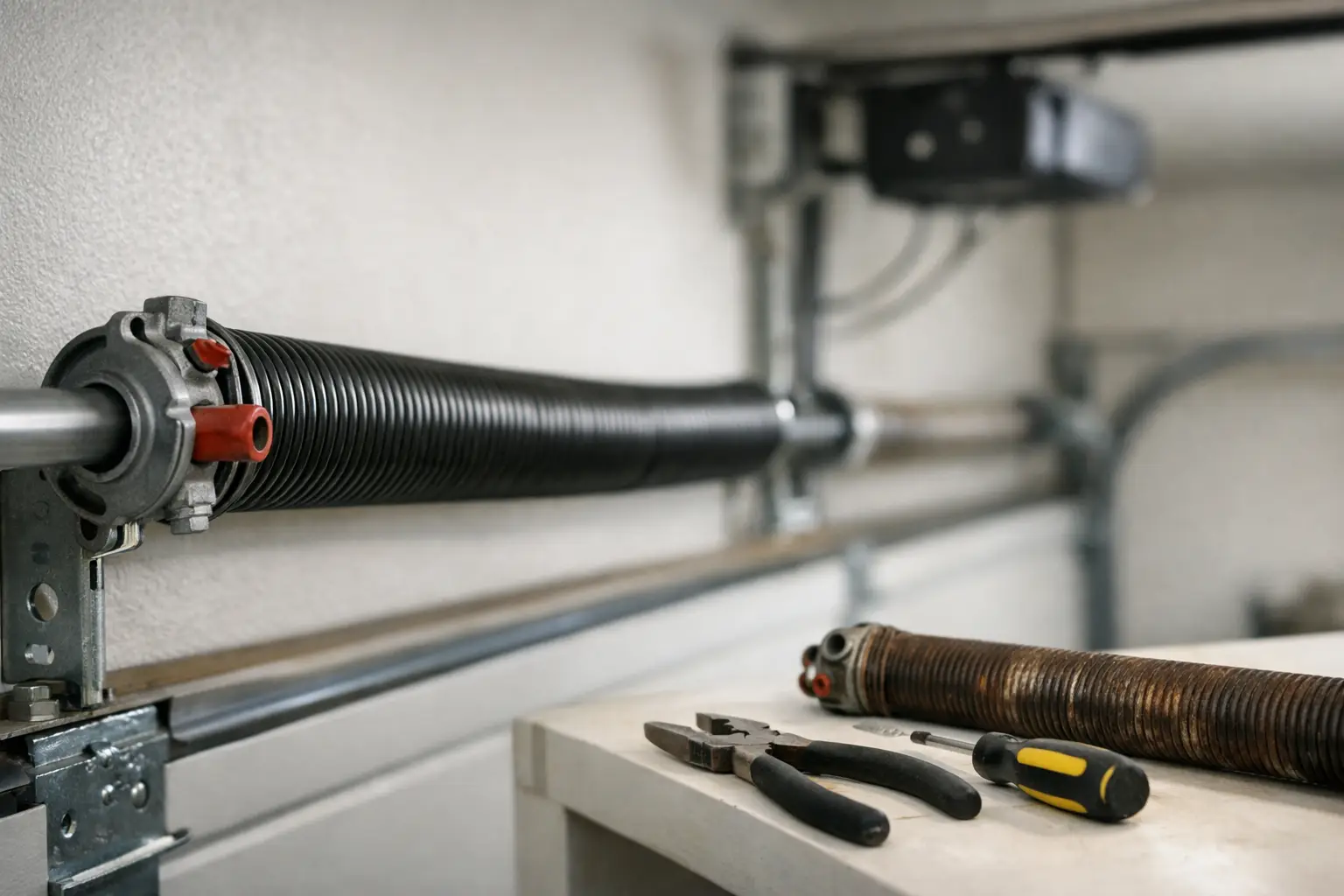
Extension springs and torsion springs also wear differently. Extension springs run along the horizontal tracks and stretch as the door closes. Torsion springs sit on a shaft above the opening and twist to lift the door. Torsion systems are common on modern residential doors because they offer smoother, more controlled operation. Both types require professional handling when replacement is needed.
Signs Your Door Spring May Be Near Failure
Springs often break without much warning, usually with a loud bang from inside the garage. Still, homeowners sometimes notice clues in the weeks or months before failure.
A door that feels unusually heavy when operated manually may have a weakening spring or a balance issue. The opener may struggle to lift the door, move more slowly than usual, or stop before the door is fully open. You may also see a visible gap in a torsion spring above the door. That gap is a clear sign the spring has broken.
With extension springs, look for uneven movement, loose coils, or a door that rises crookedly. A door that slams shut, jerks during travel, or will not stay halfway open when disconnected from the opener deserves prompt attention. These symptoms are not always caused by springs, but they should not be ignored.
Do not assume a noisy door simply needs a quick fix. Squeaking can come from rollers, hinges, tracks, or springs, and a technician should identify the source before making adjustments. The goal is not just quieter operation. It is safe, balanced movement that protects the door, opener, and people around it.
What to Do When a Garage Door Spring Breaks
A broken spring is not a do-it-yourself repair. Garage door springs hold a dangerous amount of stored energy. Attempting to wind, unwind, remove, or replace one without the right training and tools can cause serious injury or property damage.
If you believe a spring has broken, stop using the opener. Repeatedly trying to run the motor can damage the opener’s gears, rail, or internal components. Keep children and pets away from the door, and avoid standing or walking beneath it.
If the door is closed and your vehicle is inside, it may be tempting to lift it manually. That can be risky because the full weight of the door is no longer counterbalanced. If the door is open when the spring breaks, do not try to force it closed unless a qualified technician directs you to do so. An open, unsupported door can come down quickly.
A trained garage door technician can confirm whether the spring is the actual issue, select the correct replacement based on the door’s weight and dimensions, and set the tension precisely. They should also inspect cables, drums, rollers, bearings, and the opener’s force settings. Springs do not work alone, and a complete inspection helps prevent a related part from becoming the next problem.
Can You Extend Door Spring Lifespan?
You cannot prevent metal fatigue forever, but routine care can help a spring reach its expected service life. A professional garage door tune-up is the best place to start. During service, the technician can test door balance, inspect the springs for corrosion and wear, lubricate appropriate moving parts, tighten hardware, and make sure the safety systems are functioning correctly.
Homeowners can also pay attention to how the door operates between visits. Keep the tracks free of debris, listen for new noises, and avoid using the door when it is visibly off track or binding. Never apply grease to the tracks, since that can attract dirt and interfere with roller movement. A garage door lubricant applied correctly to springs, hinges, and rollers is different from heavy grease and should be used sparingly.
It also helps to reduce unnecessary cycles where practical. If the garage door is your primary entrance, extra use is not inherently bad – the system is designed to operate – but a higher-cycle spring may be worth considering at replacement time. The right choice depends on your household’s daily routine, the weight of the door, and how long you plan to stay in the home.
Should Both Garage Door Springs Be Replaced Together?
Many two-car garage doors use a pair of torsion springs. When one breaks, the other has usually completed the same number of cycles and may not be far behind. Replacing both at the same time is often the more practical recommendation because it restores balanced performance and reduces the chance of another service call soon after.
There are exceptions. If one spring was replaced recently and the other is still relatively new, a technician may recommend replacing only the failed spring. Honest guidance should be based on the condition, age, size, and cycle rating of the existing parts, not a one-size-fits-all sales approach.
Choose the Right Replacement, Not Just the Fastest One
A spring must be matched to the specific door. Door height, width, material, insulation, hardware, and actual weight all matter. Installing a spring that is too weak can overwork the opener and produce poor balance. Installing one that is too strong can cause the door to rise too quickly or create other safety concerns.
For homeowners who want fewer interruptions, ask about a higher-cycle option. For a lighter-use detached garage, a quality standard-cycle spring may be the sensible choice. The best repair is the one that fits the door and the way you use it, completed with the right parts and careful adjustment.
At Ranger Garage Door Repair, we believe a broken spring repair should leave you with more than a working door. You should know what failed, why it happened, and what to watch for going forward. If your door is heavy, uneven, noisy, or refusing to open, treat it as a safety concern and have it inspected before a small issue becomes a locked-out day.


