
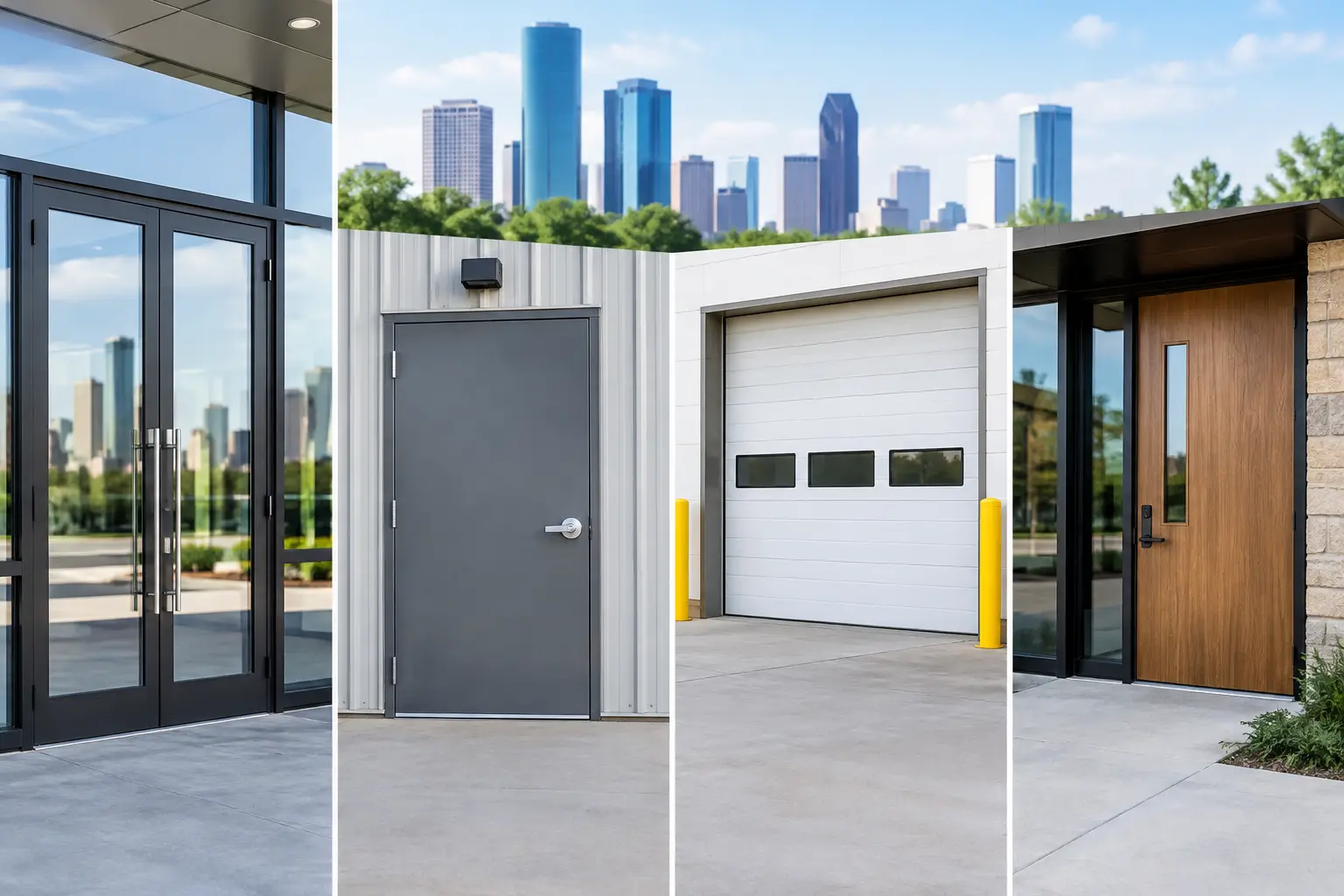
Commercial Door Comparison for Houston Properties
A commercial door comparison is not just about choosing a material or finding the lowest installed price. For a Houston warehouse, auto shop, retail storefront, or managed property, the right door affects daily access, employee safety, building security, energy use, and how long the business can stay open when something goes wrong. A door that looks similar on paper can perform very differently after years of heat, humidity, heavy traffic, and hard use.
The best choice depends on the opening, what moves through it, how often it operates, and what failure would cost your business. Here is how to compare the most common commercial overhead door options with a clear view of the trade-offs.
Start With the Job the Door Must Do
Before comparing door styles, define the door’s working conditions. A loading dock door that cycles 40 times a day has very different needs than a storage-unit door opened twice a week. Likewise, a restaurant receiving door may need visibility and quick access, while a service bay needs clearance, durability, and dependable operation.
Think through the size and weight of the equipment passing through, the amount of daily traffic, whether the opening is climate-controlled, and how exposed the door is to wind and weather. Security requirements also matter. A door behind a gated industrial site may need a different level of protection than one facing a public parking lot.
This step prevents a common and expensive mistake: installing a light-duty product in a high-cycle setting, then paying for repeated repairs and downtime.
Commercial Door Comparison by Material and Design
Sectional Steel Doors
Sectional steel doors are the workhorse of many commercial properties. They are built from horizontal panels that travel on tracks and rest overhead when open. Depending on the construction, they can be non-insulated, insulated, or heavy-duty versions designed for frequent operation.
Steel is a practical choice for warehouses, service bays, distribution areas, fire stations, and many retail back-of-house openings. It offers strong security, a clean professional appearance, and a wide range of panel designs, window layouts, and insulation levels.
The key difference is in the construction. A basic single-layer steel door may be appropriate for an unconditioned storage area with moderate use. An insulated, multi-layer steel door costs more up front but generally provides better temperature control, quieter movement, and greater panel strength. For Houston businesses with air-conditioned work areas, that upgrade can be worthwhile.
Steel can dent when hit by equipment, and coastal or highly humid conditions make proper finishes and regular inspection especially important. Still, for many businesses, sectional steel provides the best balance of cost, security, appearance, and repairability.
Aluminum and Full-View Glass Doors
Full-view aluminum doors use narrow aluminum rails with large glass or acrylic panels. They are common in restaurants, automotive showrooms, breweries, fire stations, car washes, and modern retail spaces where natural light and visual appeal are part of the property’s value.
Their biggest advantage is visibility. Employees can see activity outside, customers get a more welcoming view inside, and daylight can make a workspace feel more open. These doors also create a polished look that a solid steel door cannot always match.
The trade-off is that full-view doors are usually a more premium investment and require thoughtful glass selection. Clear glass offers maximum visibility but less privacy. Tinted, frosted, or insulated glass can help manage glare, privacy, and heat transfer. In Texas, this matters. A beautiful glass door that brings excessive afternoon heat into a conditioned space may create an ongoing comfort and energy problem.
Aluminum resists rust well, but glass panels can break from impact. For locations with vehicle traffic or higher vandalism risk, the panel type and placement deserve careful consideration.
Rolling Steel Doors
Rolling steel doors are made of interlocking slats that coil into a barrel above the opening. They are a strong choice where overhead space is limited or where security is the top concern. You will often see them at storage facilities, pharmacies, concession areas, warehouses, and secure interior openings.
Because the curtain coils rather than running on long horizontal tracks, rolling doors can preserve ceiling space. They also offer a compact, durable solution for certain openings. Heavy-duty versions are built for demanding commercial and industrial environments.
However, rolling doors are not automatically the right answer for every building. They can be louder in operation, and repairs may be more specialized when slats, guides, springs, or the curtain are damaged. Insulation options vary by model, so a rolling door should not be assumed to provide the same thermal performance as an insulated sectional door.
High-Speed Commercial Doors
High-speed doors are designed for facilities where every second of an open doorway affects productivity, climate control, cleanliness, or security. They are common in distribution centers, food operations, manufacturing facilities, and high-traffic vehicle bays.
Their primary benefit is reducing open-door time. A faster cycle can help limit conditioned-air loss, keep dust and insects out, and reduce delays for forklifts or staff. Many models include safety sensors and breakaway features that help minimize damage after an impact.
The investment is higher than a standard commercial door, and the equipment needs consistent professional maintenance. High-speed systems make the most sense when the door cycles frequently enough that improved traffic flow and reduced energy loss justify the cost.
Insulation Is More Than an Energy Upgrade
For conditioned spaces, insulation should be part of the decision from the beginning. An insulated commercial door can help reduce heat transfer, lessen outside noise, and add rigidity to the door panels. It is especially valuable for workshops, auto facilities, warehouses with offices nearby, and any business trying to control indoor temperatures during a Houston summer.
That said, insulation is not necessary for every opening. If a door separates two unconditioned areas or stays open for extended periods throughout the workday, a higher R-value door may deliver less practical benefit. The surrounding walls, roof, dock seals, and operating habits all affect the result.
Ask for the door’s stated insulation value and compare it with the actual use of the space. Paying for insulation makes sense when it solves a real operating problem, not simply because it sounds like an upgrade.
Security, Wind Load, and Fire Protection
A commercial door protects more than inventory. It may be one of the largest access points in the building, which makes security hardware, locking options, and door condition critical. A secure door also needs dependable tracks, rollers, cables, and an operator that closes and latches correctly. A strong curtain or panel is only part of the system.
Wind-load requirements deserve attention in the Greater Houston area. The right rating depends on the building location, opening size, local code requirements, and exposure. A door installed without the correct reinforcement may be unsafe and may create problems during inspections or insurance claims. This is a situation where measurements and site conditions matter more than a generic recommendation.
Fire-rated doors are another separate category. If an opening is part of a required fire barrier, the door assembly must meet its specified rating and include compatible components. A standard commercial door cannot simply be treated as a fire door because it is made of steel. Property owners should confirm the building’s requirements before replacement, especially in multi-tenant buildings and facilities with regulated operations.
Compare the Operator With the Door
A commercial operator must be matched to the door’s size, weight, cycle count, and use pattern. An undersized operator may work initially but struggle under daily demand. That can lead to premature wear, slower operation, and unexpected service calls.
Chain-drive operators are common and dependable for many applications. Jackshaft operators mount beside the door and can be useful where overhead space is limited. For heavy doors or high-cycle locations, more specialized operators and controls may be needed. Access controls, keypads, vehicle sensors, timer-to-close settings, and remote monitoring can all improve convenience, but only when configured safely for the site.
Safety devices should never be treated as optional accessories. Photo eyes, reversing controls, and properly placed warning devices help protect people, vehicles, and equipment around a moving door.
Look Beyond the Installed Price
The lowest quote can be the most expensive option if it leaves out the details that determine service life. When comparing proposals, make sure they describe the door construction, insulation level, wind rating when required, spring system, track configuration, hardware grade, operator model, safety devices, and warranty coverage.
Also ask what happens after installation. Commercial doors need periodic inspection, lubrication, balance checks, hardware tightening, and testing of safety controls. A door that receives routine maintenance is less likely to fail at the start of a busy day, when a stuck opening can disrupt deliveries, payroll, and customer access.
A quality installation should also account for the opening itself. Framing condition, headroom, side room, electrical access, floor level, and existing damage all influence what can be installed correctly. Honest recommendations begin with an on-site assessment, not a guess based on a photo.
Choose for the Next Five Years, Not Just Today
The right commercial door should fit the way your business operates now while allowing room for predictable growth. If deliveries are increasing, a higher-cycle system may be the smarter choice. If you are renovating a customer-facing space, full-view aluminum may support the look you are building. If security and limited headroom are the priority, a rolling steel door may be the better fit.
For Houston-area property owners, a careful commercial door comparison should lead to a straightforward answer: choose the door that protects your operation, meets site requirements, and can be serviced reliably for years. Ranger Garage Door Repair can help evaluate the opening, explain the options in plain language, and make sure the work is done right the first time.


